Lebra Shield vs. NextRequest for school districts
Compare Shield and NextRequest workflows, RapidReview and Risk Module considerations, human review, file support, approval and retention.

School districts comparing Lebra Shield and CivicPlus NextRequest should evaluate how staff resolve uncertainty, not simply whether the software uses AI. A useful system helps a reviewer notice a problem, understand it, correct the suggested action and carry that decision through to an approved response.
Lebra publishes this comparison. It is based on current vendor documentation and Shield’s implementation documentation reviewed on November 10, 2026. We have not performed a comparative accuracy or speed benchmark.
Understand the NextRequest configuration
CivicPlus describes NextRequest as a platform for receiving, routing, reviewing and releasing public records. Its RapidReview features include file extraction, batch redaction, comments, redaction logs and saved review work. Ask which components are included in the configuration being quoted. NextRequest product information
The separate Risk Module describes AI and machine-learning detection of sensitive information before and after redaction, with risk and review status visible in the workflow. That makes “has AI” an unhelpful dividing line between these products. Evaluate the actual review experience. NextRequest Risk Module
Have the vendor show the proposed modules together rather than presenting separate screens that your district would not license or use.
Understand Shield’s review and approval path
Shield’s documented process includes intake, scope confirmation, imported-record sorting, people confirmation, redaction review, optional attorney review and response preparation. A public request form, requester letters and a status page support the communication around the work.
The custodian retains control of disclosure decisions. When attorney review is enabled, a reviewed draft is sent to counsel. Otherwise, an authorized custodian approves it. Approval locks the decisions for final production; it does not automatically send the response.
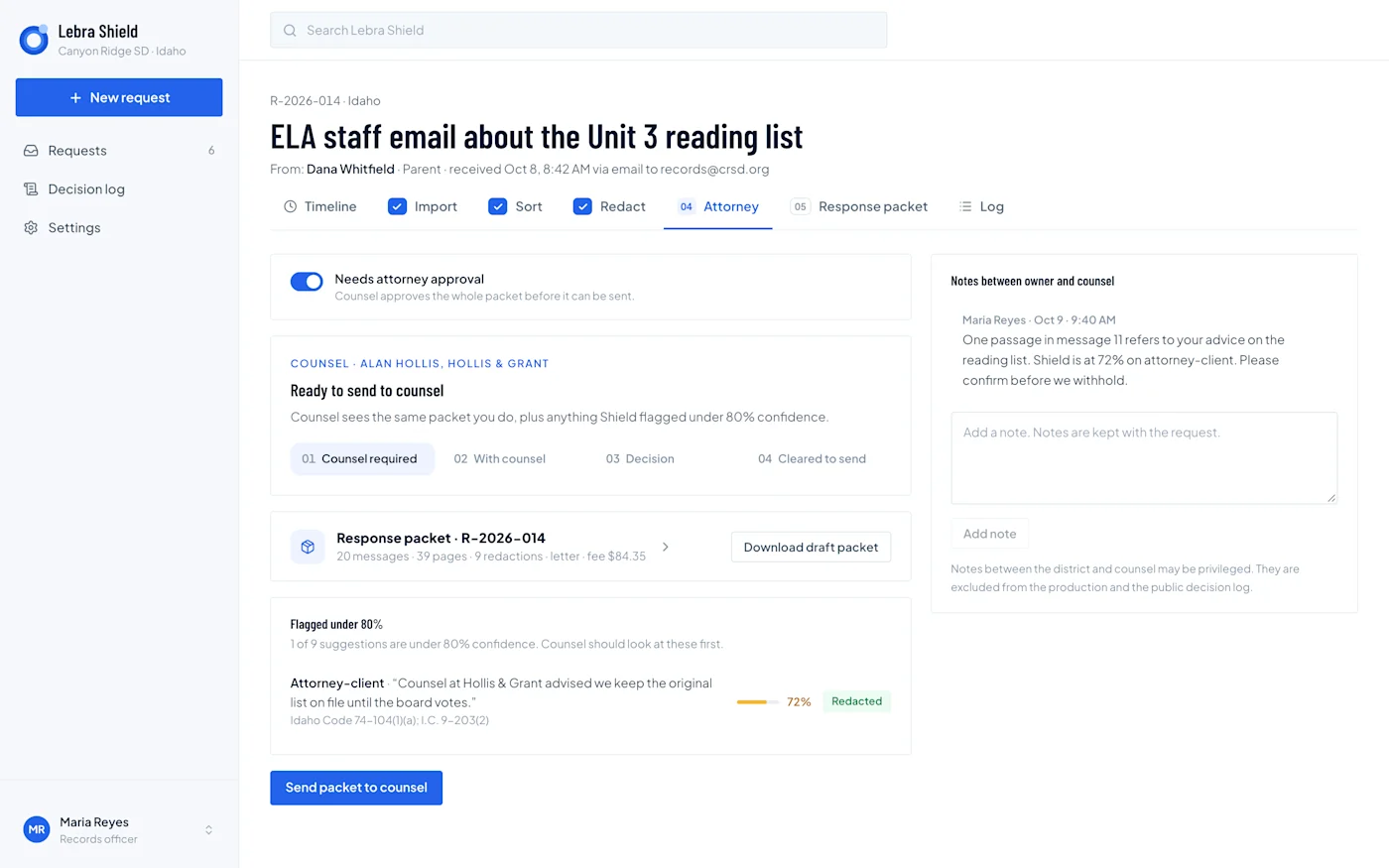
Shield demonstration Attorney screen with fictional records and people. It illustrates an optional counsel handoff; the displayed case, scores and fees are examples, not a legal determination or customer result.
For a district, the value of this structure is the ability to make ownership visible. Ask the presenter to show who can change a decision, who must approve it and what happens when counsel returns the draft.
Test ambiguous identities, not only obvious identifiers
Build a fictional email thread in which a student and a staff member share a first name. Include a personal phone number, routine public business and a passage whose meaning depends on an earlier message. Add an attachment that requires separate review.
In Shield’s current documented workflow, people are confirmed from the records. Staff can correct roles and distinguish people with the same name; the workflow does not depend on uploading an SIS roster. Have the team demonstrate that process rather than inferring it from a demo label.
For NextRequest, ask how reviewers see the context behind a risk finding, correct a classification and record a handoff. Do not assume the Risk Module makes a final disclosure decision. The district should be able to explain the final action regardless of which system initially flagged the passage.
Treat confidence scores as a prompt to review
A high score is not an approval, and an unflagged record is not a guarantee that nothing sensitive remains. Ask each vendor what a score represents and whether it has been validated on a comparable collection.
NIST’s generative AI risk profile identifies confident false output as a risk and recommends checking sources and evaluating capability claims with evidence. It does not certify either product. NIST generative AI profile
Our recommended test is simple: record missed issues, unnecessary flags, corrections and the time required to reach an approved package. Keep those results separate from the software’s own confidence values. A fast first pass can still create substantial review work.
Include collection and file preparation in the comparison
Ask your IT team for the actual export formats used by the district. A vendor’s “email support” may require a particular container, conversion step or paid module.
Shield documents uploaded Google Vault MBOX/EML and metadata alongside supported standalone records. Live system connectors, PST, OCR and a general Microsoft 365 import workflow should not be assumed available. Human inspection is required where PDFs or reproduced document content may not tell the whole story.
Ask NextRequest to demonstrate the proposed extraction and review configuration with the same files. Have both vendors account for unreadable material and attachments. A record that never reaches the review queue should not disappear from the evaluation.
Evaluate portal replacement separately
If the district is replacing its public request portal, test intake, assignment, correspondence, requester access, fees and history. If it mainly needs help reviewing exported records, prioritize that workload but still document the surrounding handoffs.
Shield has documented request-intake and requester-status functions, but fee estimates should not be confused with payment processing. Its current documented scope does not include fee invoicing and payment collection. Ask NextRequest which payment-related capabilities and associated services are included in its proposal.
Make state support explicit. Shield’s documented packs cover Idaho and Kansas; other jurisdiction requirements need confirmation. Do not infer nationwide readiness from a generic deadline field.
End with a release and retention exercise
Inspect the generated response outside the product. Confirm the final files, redactions, attachments, letter and approval record. Then ask how a colleague would recover the exact released version later.
Shield purges working request content on closure. The district must export its required production and audit material before that action and maintain its approved retained copy. Ask NextRequest to demonstrate its retention and export behavior as well.
Use a common scorecard and contract scope so the comparison reflects your district’s workload. The public records toolkit supplies practical handoff records. Schedule a Shield demonstration and bring the same fictional test collection to both vendors.
See what Lebra Shield can do for your district.
Schedule a demo